EN
EN
 AR
AR
 HR
HR
 CS
CS
 DA
DA
 NL
NL
 FI
FI
 FR
FR
 DE
DE
 EL
EL
 HI
HI
 IT
IT
 KO
KO
 NO
NO
 PL
PL
 PT
PT
 RO
RO
 RU
RU
 ES
ES
 SV
SV
 TL
TL
 IW
IW
 ID
ID
 LV
LV
 LT
LT
 SR
SR
 SK
SK
 SL
SL
 VI
VI
 SQ
SQ
 ET
ET
 HU
HU
 TH
TH
 TR
TR
 MS
MS
 IS
IS
 LA
LA
 KK
KK
 UZ
UZ
 KY
KY
Why we choose 5#zinc alloy for our conceal hinge production?
Why we choose 5#zinc alloy for our conceal hinge production?
Choosing the Right Strength: Why 5# Zinc Alloy Makes All the Difference in Concealed Hinges
When selecting hardware for flush, minimalist doors, concealed hinges are the ultimate choice for a clean aesthetic. But a hidden hinge is only as reliable as the raw material it is cast from. Most standard zinc hardware on the market is made from 3# zinc alloy
Let's break down the technical differences between these two materials and why the upgrade matters for your doors.
The Core Difference: Material Composition
The fundamental distinction between 3# and 5# zinc alloy lies in their chemical makeup, specifically the introduction of Copper (Cu)
-
3# Zinc Alloy: Contains almost no copper<0.03% I . It features an aluminum content of 3.9%-4.3%and a magnesium content of 0.03% -0.06%, with the remainder being zinc
. -
5# Zinc Alloy: Explicitly introduces a precise amount of copper, measuring between 0.75%-1.1%. The aluminum 3.9%-4.3% and magnesium 0.03%-0.06% levels remain identical to 3# zinc
.
While a 1% addition of copper might seem small, it completely alters the molecular structure, drastically improving the mechanical capabilities of the metal
Mechanical Performance Showdown
Because concealed hinges are deeply recessed and bear the constant gravitational pull of heavy doors, mechanical performance is everything. The data reveals a significant gap between the two alloys
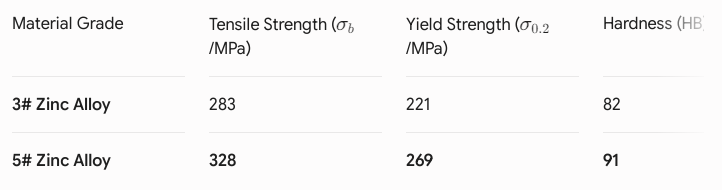
1. Tensile Strength (328MPA VA 283 MPA)
Tensile strength measures a material's resistance to breaking under tension
2. Yield Strength (269MPA VS 221 MPA)
Yield strength is the point at which a metal permanently deforms or bends
3. Brinell Hardness (91HB VS 82 HB)
With a hardness rating of 91 HB, 5# zinc is significantly more resistant to surface wear, friction scratches, and structural fatigue at the hinge pivots than its 3# counterpart
What This Means for Your Concealed Hinges
Concealed hinges manufactured using standard 3# zinc alloy typically suffer from weaker mechanical characteristics, making them suitable only for lightweight, small-capacity interior doors
By upgrading to 5# zinc alloy, manufacturers utilize superior fluid fluidity during the die-casting process alongside optimized strength profiles
-
A much higher overall structural load capacity
. -
An extended lifespan for the hardware, preventing door drag
. -
Seamless, crisp operation even under heavy or frequent residential and commercial use
.
Conclusion
When investing in invisible door hardware, looks aren't everything—what happens beneath the surface matters most. Choosing concealed hinges engineered from 5# zinc alloy ensures your modern, minimalist doors stay perfectly aligned, stable, and smooth for a lifetime
Recommended Products
Hot News
-
Where zinc alloy material is applied ?
2026-05-31
-
Door conceal hinge produce cost analysis in 2026
2026-05-30
-
How to install conceal hinge in door?
2026-05-24
-
Why we choose 5#zinc alloy for our conceal hinge production?
2026-05-22
-
Top 10 door conceal hinge manufacturer in 2026
2026-05-23
-
Hidden Hinges: The Invisible Solution for Seamless Design
2024-11-08
-
The Advantages of Alloy Concealed Hinges in Modern Architecture
2024-11-04
-
Shedding water in the big river, struggling to break the waves----Jibang Group's 2024-2026 business goals and 2024 annual business plan meeting was successfully held
2024-01-22
-
Good News: Jibang Precision Becomes Guangdong Provincial Manufacturing Single‑Champion
2026-08-28
-
The wind is strong and the sails are sailing. It is the right time to work hard.
2024-01-22